Structural Drying in Dallas, GA
Drying a house is a measured job, not a matter of running fans. The drying team places air movers and dehumidifiers by room, reads moisture in framing, subfloor and drywall, and adjusts the setup until the numbers fall.
(888) 532-4616Call about drying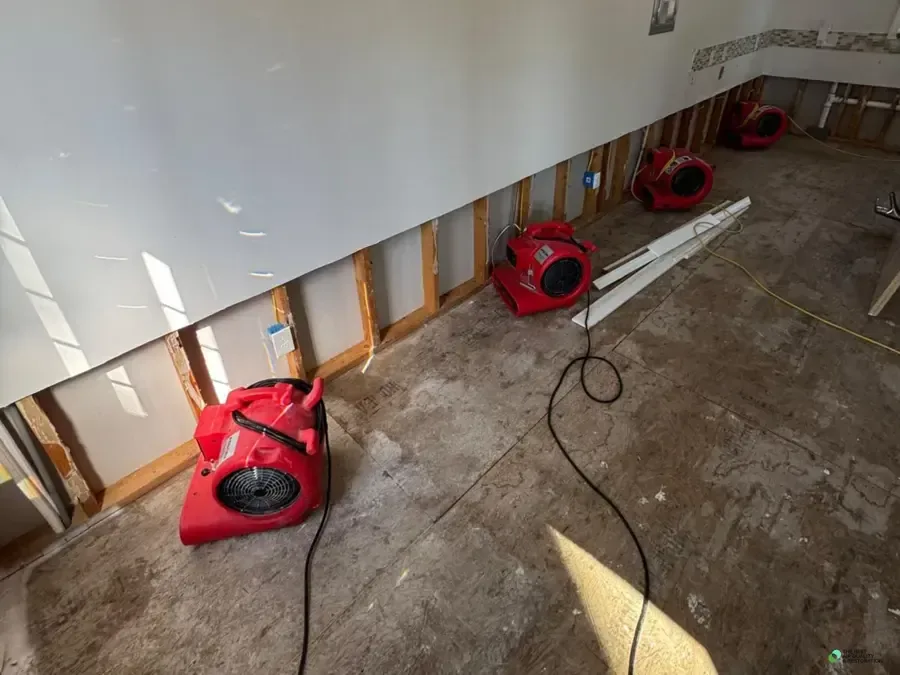
Why structural drying and dehumidification needs a measured dry-out
Dispatch at any hour
The response team dispatches 24/7, and active water is treated as urgent on weekends and holidays too.
Dried to IICRC S500
Air movers and LGR dehumidifiers are sized to the class of loss, and readings decide when equipment leaves.
Claim-ready records
Moisture maps, daily psychrometric logs and timestamped photos are taken before any demolition.
Water and sewage only
Extraction, structural drying and Category 3 cleanup are the whole job, from the first call to the last reading.
First steps for structural drying and dehumidification while help is on the way
A few safe moves for the household before the crew arrives.
- 1
Keep the area closed. Doors and windows shut let dehumidifiers work.
- 2
Leave equipment running. Air movers and dehumidifiers need to stay on.
- 3
Keep furniture off wet floors. Wood legs stain and wick moisture.
- 4
Report new stains. Tell the drying team about changes.
What does structural drying and dehumidification cost in Dallas, GA?
Structural drying in Dallas typically runs from $1,000 for a Class 1 or 2 area to $6,500 or more for Class 4 dense materials, and equipment days and room count set the price.
Class 1 or 2, one area
- Air movers
- Dehumidifier
- Readings
Class 3, several rooms
- Added equipment
- Cavity drying
- Daily checks
Class 4, dense materials
- Specialty drying
- Extended runtime
- Full records
Ranges are typical, not a quote: the water category, square footage, material class and how fast drying started move the number most. Run the water damage cost calculator for a closer range; the claim file carries the moisture map and photos either way.
How structural drying and dehumidification is handled, step by step
Measure moisture
Readings map wet materials.
Set the equipment
Placement follows the readings.
Monitor progress
Readings repeat each visit.
Remove and record
Equipment leaves when dry.
Structural drying begins once the standing water is gone and decides whether wet framing, subfloor and drywall can stay. In Dallas homes the plan follows what the moisture meter reads room by room, since every house holds water differently.
How classes of damage differ
Drying difficulty is graded by class. Class 1 involves little absorbent material, Class 2 a wider wet area, Class 3 water that came from overhead and Class 4 dense materials such as hardwood or plaster that release moisture slowly.
- Class 1 and 2 jobs involve limited wet areas
- Class 3 follows water from the ceiling down
- Class 4 covers dense materials that hold water
The class sets how much equipment goes in and how long it stays.
Equipment and placement
Air movers push dry air across wet surfaces while dehumidifiers pull the water out of the air. Placement follows the room's shape, open cavities and the readings, not a fixed pattern.
- Air movers angled along walls and floors
- Dehumidifiers matched to the volume of air
- Wall cavities opened or vented where needed
Doors and windows stay closed so the dehumidifiers work on the air in the room.
Wet walls or floors? Call about a moisture check and a drying plan.
(888) 532-4616Ask about structural dryingKnowing when it is dry
Readings are taken on each visit and compared with dry reference points from unaffected materials. Equipment comes out when framing, subfloor and drywall reach the target, which also ends the 24 to 48 hour concern about mold.
- Readings recorded for each room
- Dry reference points taken from unaffected areas
- Final readings saved with photos
Surface water is handled first under water extraction, and the structural drying overview explains the full process.
Check the numbers before the walkthrough
The water damage cost calculator and the drying time estimator give typical ranges for a local home. The walkthrough and moisture map set the real scope.
Structural drying and dehumidification across Dallas and nearby communities
Dispatch reaches every neighborhood listed here, day or night.
Drying work covers homes across Dallas, from developments such as Heritage Club and Overlook to Cole Creek, and addresses in both ZIP codes, 30132 and 30157.
The same service nearby: structural drying and dehumidification in Villa Rica, Austell, Bremen.
See every service for this townRelated water damage services in Dallas
Structural Drying and Dehumidification questions in Dallas, GA
Still dealing with it?
Wet walls or floors? Call about a moisture check and a drying plan.
(888) 532-4616 (888) 532-4616Ask about structural dryingHow long does structural drying take?
It depends on the class of damage, the materials involved and how many rooms are wet. Moisture readings, not the calendar, decide when the equipment can leave.
Why do the dehumidifiers run with the doors closed?
A closed space lets the dehumidifiers pull moisture from the air instead of drawing in humid outside air. Open windows slow the work and keep materials damp longer.
Can wet drywall be dried in place?
Sometimes. Clean water caught early often allows drywall to dry with air movement, while soaked or contaminated sections are cut out and replaced.
How does the drying team know when materials are dry?
Readings from affected areas are compared with dry reference points taken from unaffected materials in the same house. When they match, drying is complete.
Are the drying machines noisy to live with?
Air movers and dehumidifiers are loud and draw electricity, which is why the setup is adjusted as readings improve and removed as soon as materials are dry.
Dry to the numbers, not to the touch
The drying team measures every wet material, sets equipment room by room and records readings until framing, subfloor and drywall are dry.
(888) 532-4616Call about the drying plan