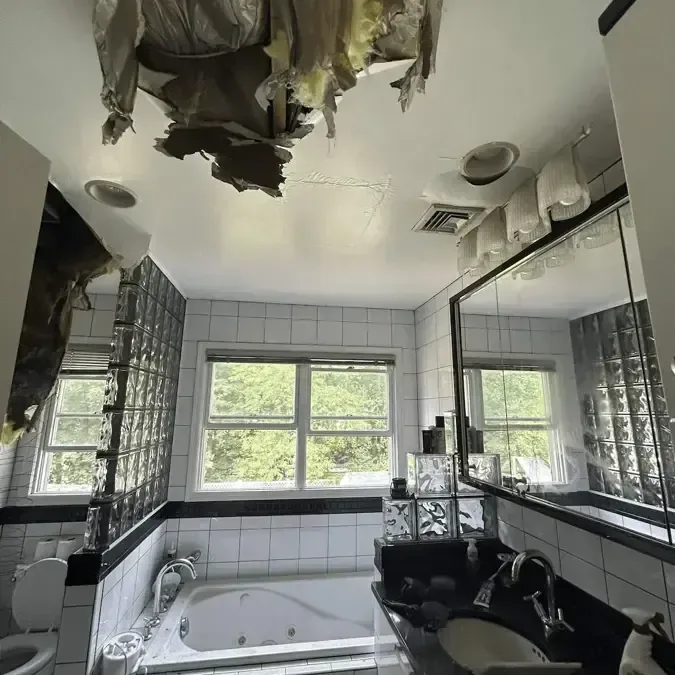
Homes in Villa Rica built from the late seventies to the mid nineties often carry gray polybutylene supply pipe, and older houses still have galvanized steel. Either one can fail inside a wall long before anyone sees a drip.
Key takeaways
- Gray plastic supply pipe from the late seventies to the mid nineties is a common source of sudden leaks inside walls and ceilings.
- Close the main water valve first, then open a low faucet to drain what is left in the pipes.
- A water meter that keeps moving with every fixture off points to a hidden leak.
- Stained ceilings and soft drywall show where the water ended up, which is not always where it started.
- A plumber stops the leak and repairs the pipe. The restoration crew extracts the water and dries the structure.
Why older supply pipe fails inside the wall
Polybutylene was a common choice for supply pipe in the years before it fell out of use. It is easy to spot as gray plastic, often near the water heater or where the supply enters the house.
The pipe itself is not the only weak point. Joints and fittings are where many of these systems give way, and they tend to hide in walls, ceilings and crawl spaces.
Galvanized steel fails in a different way. It rusts from the inside, narrows over time and finally pinholes or splits.
Because supply pipe stays under pressure all day, a weak joint does not wait for a convenient moment. A small weep at a fitting can turn into a steady release as pressure rises overnight or after the water heater cycles.
- Gray plastic pipe near the water heater or the meter is worth showing to a plumber.
- Galvanized pipe with rust stains and weak water pressure is near the end of its life.
- Leaks often start at a joint, not in the middle of a run.
Signs of a hidden leak
Pipes in a wall or ceiling do not announce a leak the way a dripping faucet does. The signs show up on the finish surfaces, and by then the water may have been moving for a while.
Floors tell the story as well. Laminate that lifts at the seams, vinyl that bubbles and carpet that feels cold or damp under foot can all sit above a pipe that has been leaking quietly.
Signs inside the house
A ceiling stain that spreads after the rain has stopped is a classic clue. So are bubbling paint, baseboards that swell and a floor that feels warm or soft in one spot.
- Brown or yellow ceiling stains that grow.
- Peeling paint or damp drywall on an inside wall.
- Musty smell in a room that was fine last week.
- Hissing or dripping sounds inside a wall.
Signs at the meter and fixtures
Turn off every tap and appliance, then look at the water meter. If the dial or the small leak indicator keeps moving, water is escaping somewhere inside the system.
A sudden drop in pressure at one fixture can also mean a split in the pipe feeding it.
What to do when a pipe lets go
Speed matters because a split supply pipe can release water at full pressure. A few steps cut the damage before help arrives, and none of them needs tools.
A ceiling that bulges with water can be relieved by puncturing a small hole at its lowest point, with a bucket underneath. That drains the weight before the drywall gives way, and it is far easier to repair than a collapsed ceiling.
- Close the main water valve. Know where it is before a leak happens.
- Open a faucet on the lowest floor to drain the rest of the pipe.
- Switch off power to wet areas if water is near outlets, light fixtures or ceiling fans.
- Move rugs, electronics and furniture out of the wet area.
- Photograph the damage and the pipe before anything is moved, and keep the failed section if possible.
- Call a plumber for the repair and a restoration crew for the water.
How the crew finds and opens the wet area
A split in a wall rarely soaks just one spot. Water follows framing, runs down inside the cavity and spreads under flooring, so the crew maps the damage instead of guessing.
Moisture meters and a thermal camera show how far the water traveled. Where drywall is soaked, the crew often cuts it open higher than the visible stain so the wet cavity can breathe and dry.
The first job on the floor is water extraction, because standing water keeps feeding the walls and subfloor. Wet insulation comes out with the damaged drywall.
When the leak is above a ceiling, the crew also checks the attic or the floor system above for wet insulation, since it holds water and keeps feeding the ceiling below. Each opening is kept as small as the readings allow.
- Moisture mapping across walls, ceiling and floor.
- Controlled cuts in drywall to open the cavity.
- Removal of insulation and materials that cannot be dried.
- Photos and readings kept for the insurance file.
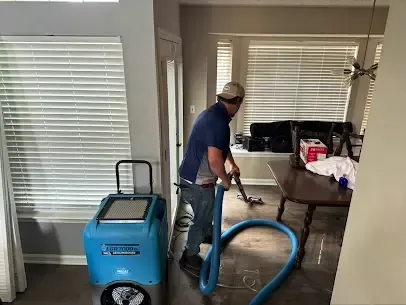
Drying the cavity and the floor
Clean supply water is Category 1 at first. If it sits in a wall or under flooring for long, it can slip to Category 2 as it absorbs what is in the materials, which is another reason not to wait.
Structural drying uses dehumidifiers and air movers, often with hoses that push dry air straight into a wall cavity. The crew checks readings each visit and stops only when the framing reaches the target for dry.
Owners who want a rough timeline can try the drying time estimator, then expect the actual schedule to follow the readings.
Floors need the same care. Hardwood and laminate can swell, and carpet pad holds water, so the crew decides what can be dried in place and what has to be lifted.
Repairing the pipe and avoiding a repeat
A plumber decides between patching one section and replacing a longer run. With older pipe, a patch can leave other weak spots in place, so ask for the full picture of what the system looks like.
The burst pipe water damage work comes after the leak is stopped and before walls are closed. Rebuilding should wait until readings show the wood and drywall are dry.
Keep every receipt and the failed pipe section if possible. An insurer may ask to see what failed, and the photos taken early help show that the damage was sudden.
- Ask the plumber what other pipe in the house is the same type.
- Learn where the main valve is and test it once a year.
- Replace flexible hoses on appliances before they age out.
- Tell the insurer what the plumber finds.
Questions
How do I know if my house has polybutylene pipe?
It is usually gray plastic, seen near the water heater, the meter or under sinks. A plumber can confirm the type and mark where it runs.
Will homeowners insurance cover a burst pipe?
Many policies cover sudden water damage from a pipe failure, though they may treat long term seepage or the pipe itself differently. Check the policy wording or ask the insurer.
How long does a wall take to dry after a pipe bursts?
It depends on how much water the materials took on and what they are made of. Drying often takes several days, and readings decide when it is finished.
Can a leaking pipe just be patched?
Sometimes, but a plumber should judge it. Old pipe can fail again in another spot, so a patch may only buy time.
Is water from a burst supply pipe safe to touch?
It is clean when it leaves the pipe, but it can become contaminated by building materials if it sits. Avoid contact with water that has soaked insulation or been standing for a day.
Should the whole house be repiped after one leak?
That is a plumber's call. Some owners fix only the failed section, while others replace a whole run or the full system, especially if the same type of pipe runs throughout the house.